Resident Evil: Requiem – NXG Technical Review
Share the Story:
Ageing with Grace
Re engine is approaching its 10th birthday, almost as old as the MT frameworks engine it replaced with 2017s resident evil VII. With the biohazard series celebrating 30 years, coinciding with this new game being set circa 30 years after Resident Evil 2/Resident Evil 3:Nemesis.
But, like Leon, it has continued to age with grace, learning new tricks now it is on PC and current Gen consoles only. Yes, RT reflections were added to previous games post launch, but it is improved here and, exclusive to PC, now supports full path Traced lighting, but what does this mean.
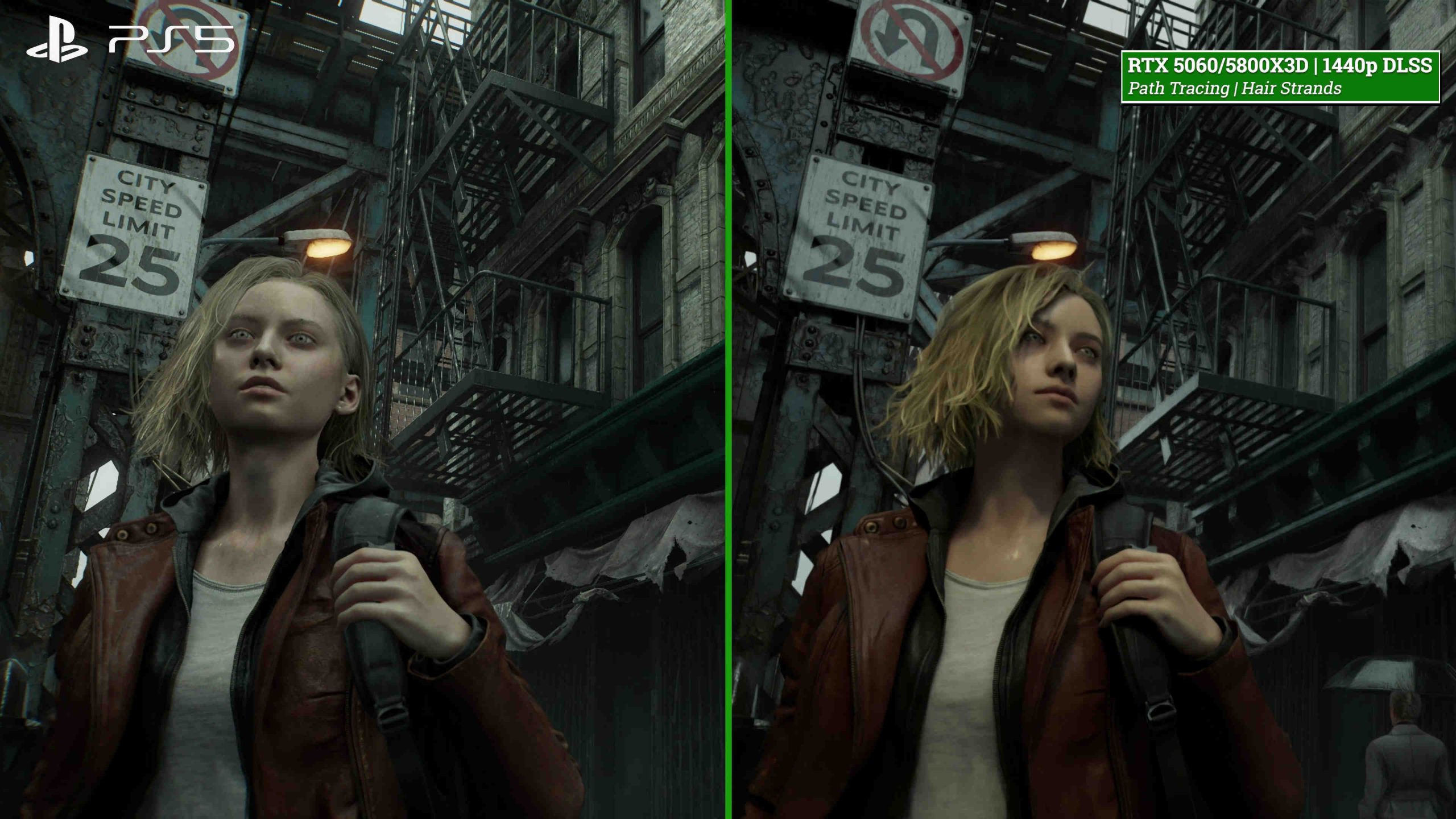
Well Lighting, shadows and detail are all ramped up dramatically, with the core RE engine always being built around and to replicate, film quality lighting, PB material reactions, and photogrammetry, digitised assets. Always delivering a realistic, gritty but stylish look that balances film and fiction very well, with a keen focus on faces, eyes, flesh, gore and more so recently, hair. Building on RE4 remake hair splines, which were more an afterthought, here Leon, new protagonist Grace, and even enemies and monsters, all have polygon-based hair geometry that collides, self occluders and supports sub surface scattering, which is clearly the baseline for the models and art design. The old card system is still present, but the visual change is stark and hard to go back once enabled. Lighting wise! it still supports old fashioned rasterised lighting, ambient Occlusion, cube maps, shadow maps, SSR and great art. Vitally so for consoles, as only the PS5 Pro supports any Ray Tracing at all, with base PS5, Series X|S and Switch 2 only offering the baseline option. Not so for PC where we can bump up to RT in 2 guises, normal and High and then the top end Path Traced choice.
REflecting on the World Around
Ray Tracing only adds Ray Traced Reflections, with planar surfaces like wet signs, bathroom mirrors, glass and car windows all reflecting both static and dynamic objects, such as yourself, zombies or busy suit men and women. The 2 modes only seem to differ in Rays per pixel and possibly denoising, with reflected objects from within the BVH proxies being slightly more stable and less jittery.
Path Tracing is the holy grail, offering a full lighting facelift over the raster-based light and Shadow system. Reflections remain, although now much more stable and cleaner, helped by Nvidia’s Ray Reconstruction now being engaged in this Nvidia Exclusive option. Sadly, disabled and locked out of Ray Tracing modes which is a shame and makes the increases to Path Tracing far bigger than they would ordinarily be. I hope this is patched soon to add the option to enable without path tracing. In addition to the enhanced reflections, we also see more accurate and dynamic light bounce. Lights have a much longer Cascade Range and interact with more objects and characters, create more shadows and have a greater level of light sources throughout. We see far more and much better shadows and self-occlusion on objects and even very small triangle objects such as these cherubs on the door. Colour tones and surfaces have a great range of reactions and subtlety between wet or dry, light or dark and more, all shadows now exhibit soft contact hardening and are more stable. Great and more precise diffuse lighting, emissive lights from shop windows hitting graces hair and clothes, and far greater accuracy in shade, irradiance bounce, material reactions from wet skin, hair, brick, wood or disembowelled intestines, which, in horror games, works incredibly well, emphasising atmosphere, building tension and improving materials, world and model quality.
REanimator
The Animation team in Capcom RE studios is top tier in the field, again we see the superb physics based locomotion and reaction systems covering many enemy types, limbs, inverse-kinematics and these are mixed with canned animation sets from Leon doing a Jean Claude roundhouse before stomping on heads, or a Zombie doing his best Ash impersonation with a chain saw. Clearly inspired by Sam Raimi’s comedic style of speeded up action as it fails to understand the mechanical beast and is dragged across the floor, always aiming for you, before returning to the grave, minus a limb or two. Incidental animations like this are great as are the motion and performance capture in gameplay and Realtime cinematics, facial models remain excellent and facial bone rigs are generally very good but can be the weakest aspect at times and even reduced over prior games. Leading to stiffer faces and reduced emotion at points in the game, but it can a mixed level. The game also uses some level of environmental destruction and although no procedural, is dynamic and creates a convincing level of physics within canned sections. One area that is weaker is the big reduction in procedural gore and zombie reactions from RE2 Remake. Even Re3 was cutback and here again we see some level of procedural limb, torse and head process but this is, sadly, significantly reduced over the RE2R as I noted in preview last month looked to be the case. However, what remains is still excellent, as are models, environments, hair and faces during the gameplay and real-time cutscenes.
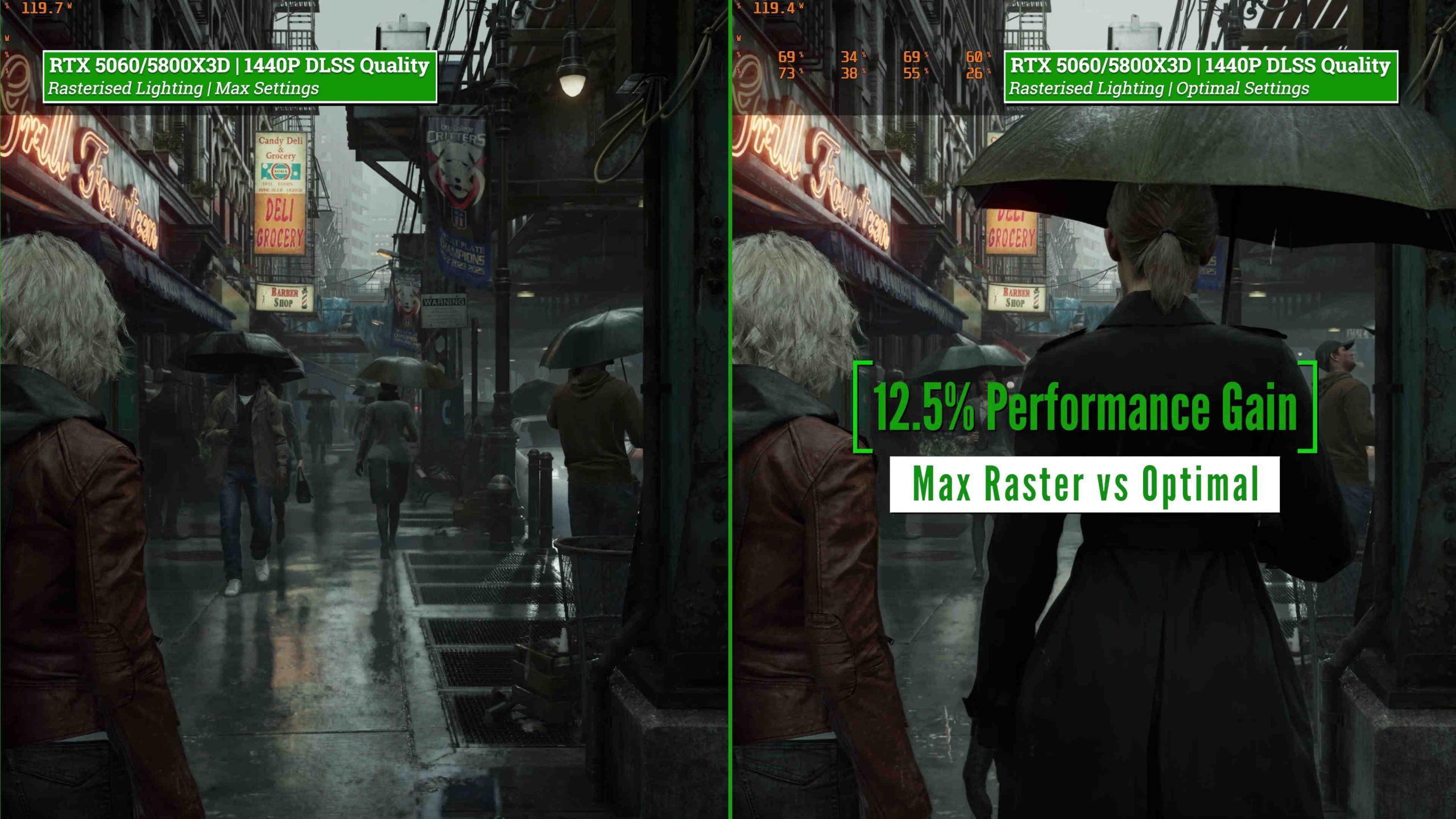
Optimal Settings and Performance
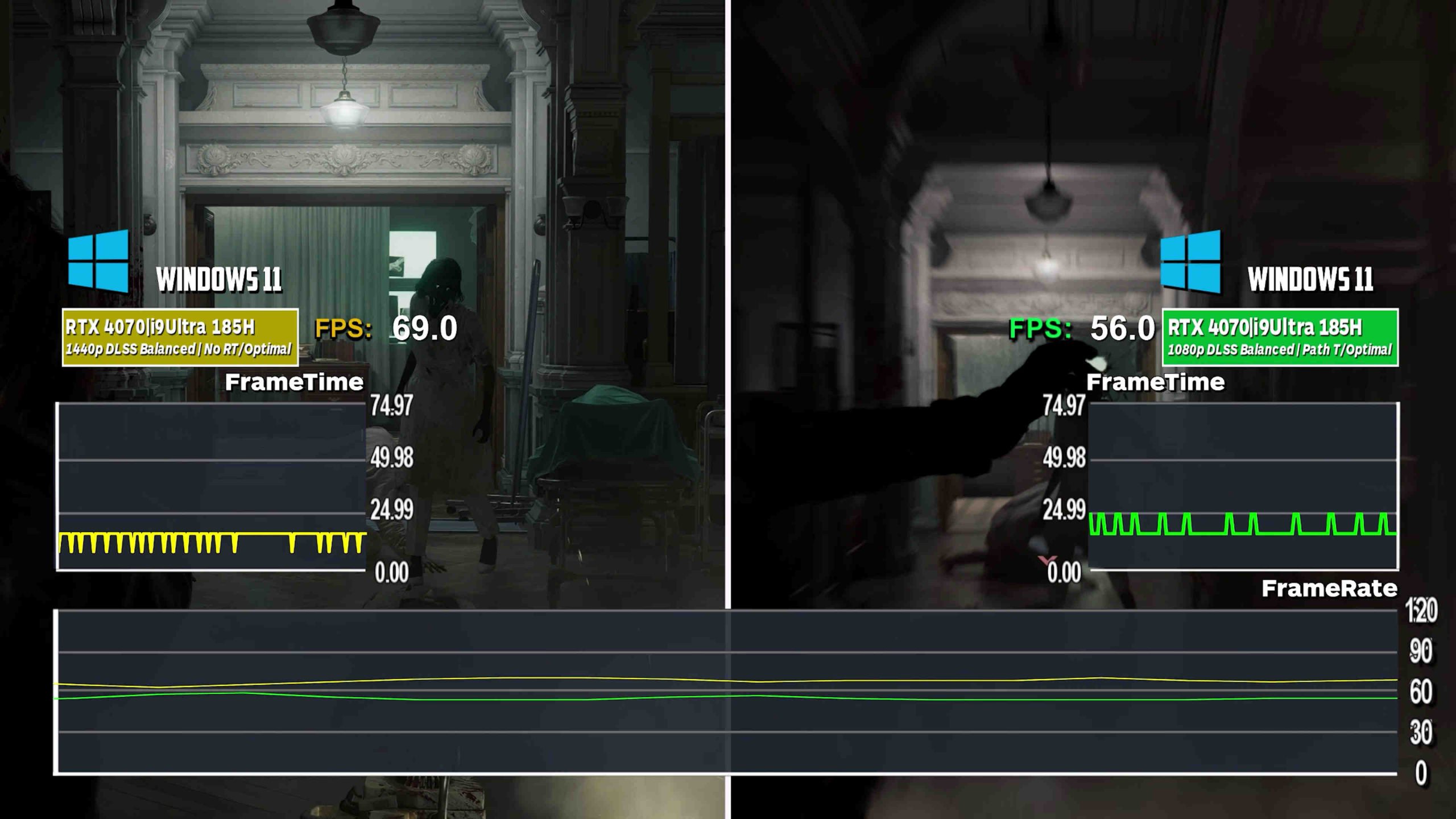
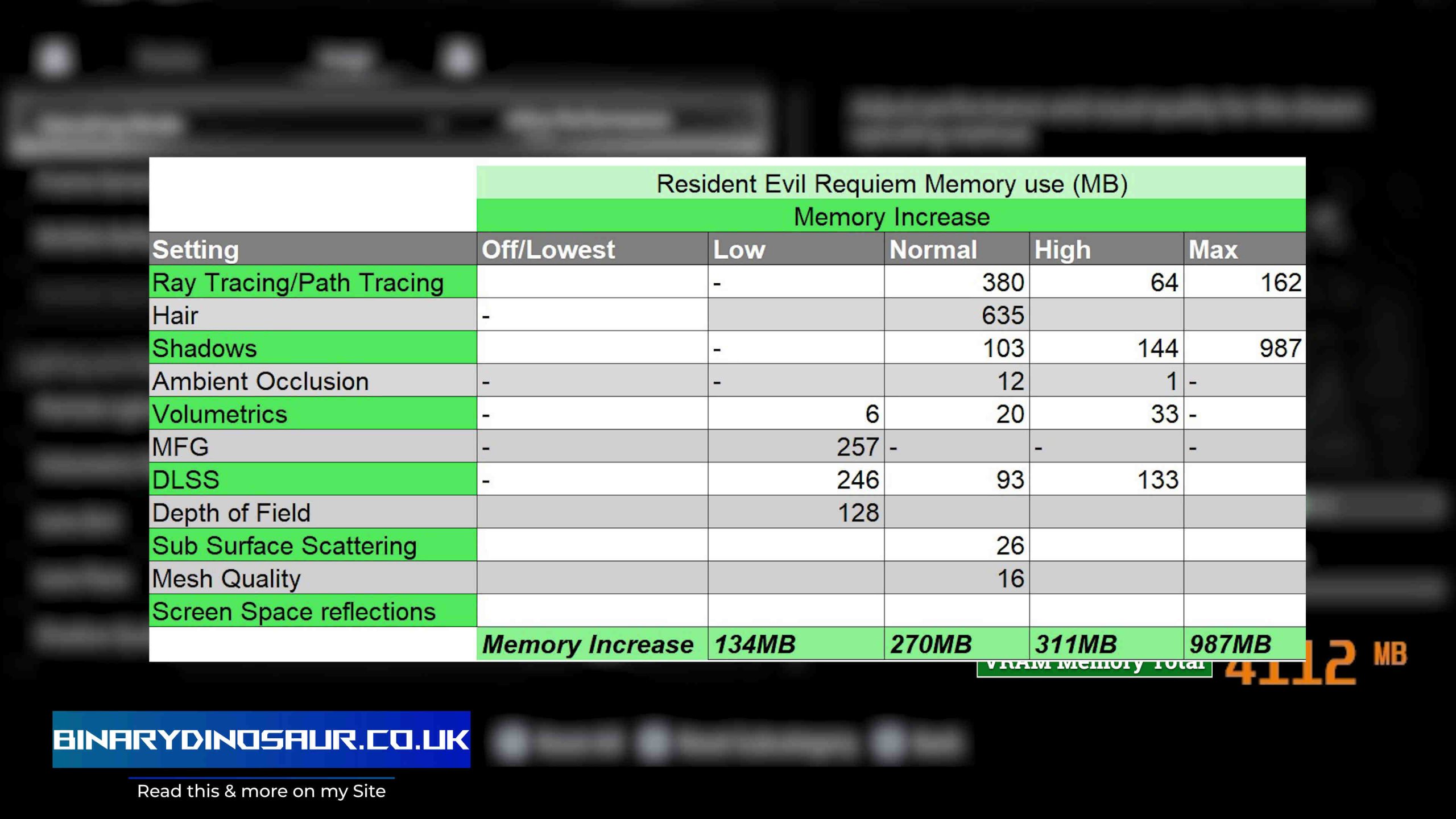
The video covers all the options, modes, memory and Ray Tracing, Path Tracing costs across a selection of Nvidia RTX 4070, RTX 5060, RTX 5080 and AMD RX 6800 GPUs and a selection of CPUs. This helps all users pick the best balance of memory use, Path Tracing and performance to hit their target goals. And all Nvidia GPUs can run this game with Path Tracing enabled using the settings covered in the video, even 8GB GPUs.
Final Verdict
Resident Evil continues to deliver high quality, fun, scary, and above all enjoyable action. RE9 is a mix of RE4 meets village and ramps up the pastiche / parody of Dawn of the Dead into Evil Dead. It works and the blend of vulnerable scares from Grace’s chapters crossed over with Leon Statham’s gung-ho is a great meld of genres. Technically it still delivers excellent quality and performance, but the core models, assets, bone rigs and more can look dated without the newer Ray Tracing and hair feature set enabled.
PC is where it looks, runs and works best. The PS5 version is still great but no RT even at 30fps is a shame, the Nvidia path Tracing does fix many issues with the games visuals and elevates it drastically over the console version even on the RTX 4070 and RTX 5060. Ray Recon is a huge boost to the Ray Tracing issues and denoising, along with far superior shadows, real time reflections, improved AO (even on the base RT mode over Raster) it elevates models, scenery and more considerably. As I have covered the cost is high and this title almost needs MFG to get close to 120fps, but it can scale across hardware. It would be good to see more choice in Ray and path Tracing such as modular options, ray recon for RT and better denoising, shadows and AO for the base game. Some of the issues I noted are clearly a case of the team baseline on the RT feature set. The RTX 5080 is a monster of a card and is the only card that gives the game a true 4K like IQ and although it runs well, even that card needs interpolation to deliver a 120Hz output with all rays being traced.
Maybe later patches will offer more modular choices, but Capcom have delivered another hit here and with the aid of Nvidia’s Technical chops, the RE Engine it has never looked so good and has extended its life for another year or so.