
DLSS 4.5 Dynamic Multi-Frame Generation launches for 200+ games on March 31st
Share the Story:
Seeing Double
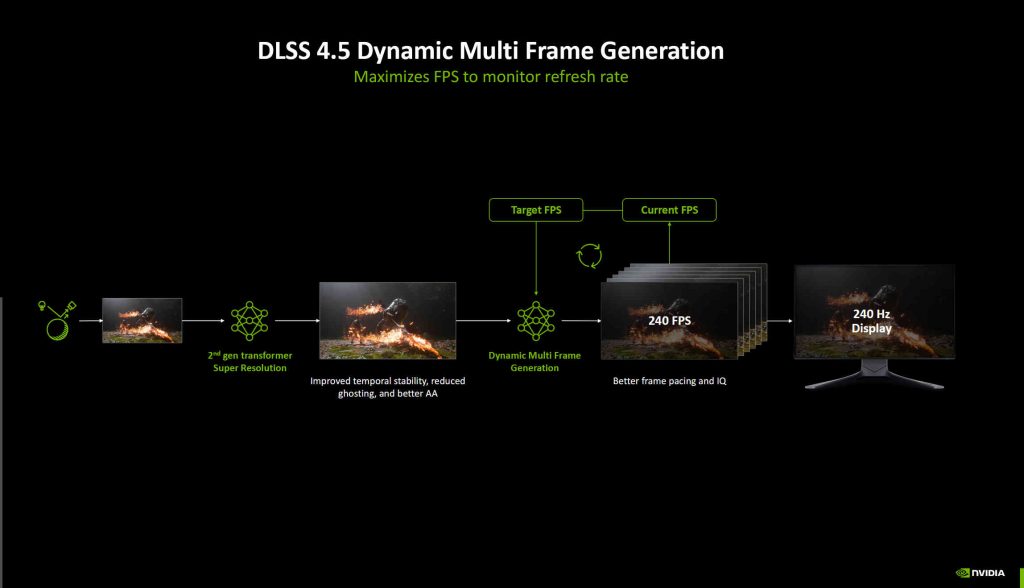
Like it or not, pixel projection, image reconstruction, and frame generation are now a part of the gaming technology ecosystem. Both on PC and consoles, the method of development has changed to create a “One-Size-Fits-All” approach to the difficult task of shipping a game across multiple hardware specs and targets. Earlier this year Nvidia announce DLSS 4.5 that offered enhanced image reconstruction and also the pending Dynamic Multi-Frame generation option, which is the best choice for this technology in my opinion.
At GDC this week, Nvidia announced that the new technology would come on March 31st via an update to the Nvidia APP and the latest drivers [595.79 WHQL] would be required to support all new features. The technology I have covered in previous videos and articles, and I tested it myself last month at an Nvidia Press event in London. In short the it allows the game rendering to scale the interpolated frames dynamically just like resolution on a frame by frame basis. The main reason I am in favour of this, is the technology should only ever try ty smooth out your target frame-rate to align to your screens refresh. And the solution, which should be supported in approximately 200 games that currently support DLSS MFG, will scale that level of generated frames based on your target refresh rate and the gap between the rendering power to meet that and the deficit that needs to be picked up by the DLSS dMFG solution.
The demo I saw used the technology to hit 360fps output with a combination of pure rendering grunt and frame generation. By the Nvidia Overlay showed the multiplier of the frame generation shifting based on the load hitting the GPU per frame. It fluctuated between 4x and 6x levels quite often with the relevant power and input latency peaks and troughs happening equally as quickly. And this is the use case for MFG and where it works best as the target output is the key reason for it, to ensure the game pushes a new frame at the same rate as the screen does. And like Variable Refresh Rate (VRR) the more these are aligned the smoother the game feels to play and look at, but the other benefit is that it can drop to a low level, and maybe even turn off completely, when the GPU power and game rendering demands align.
I am keen to cover the technology once we get access to the new App and driver across a selection of games, with a keen focus on the use cases, pros and cons, and what areas may be a challenge for the solution. Stay tuned to the Channel and site for more in the coming weeks.


Pingback: DLSS4.5 Ray Reconstruction will brighten our Summer - Binary Dinosaur