DLSS4.5 Ray Reconstruction will brighten our Summer
Share the Story:
Ray-Bans for all
Nvidia continue to iterate on their industry leading reconstruction and Ray Tracing technology. Only a few months after they released DLSS 4.5 into the gaming sphere earlier this year. This was then later improved further with the Dynamic Multi-Frame Generation 4.5 update that landed on March 31st. Both of these significantly improved on the champion upscaler when reconstructing lower resolutions to a higher base. Now they have implemented the same 2.0 Transformer model into their Ray Reconstruction feature set within their exhaustive DLSS image suite. It was not lost in me that this has come out months after the, largely negative reception of their next generation DLSS 5.0 suite, which appears to have gone back into the oven for a while. That is not such a bad thing, and I think this latest update will be warmly received by the PC audience, myself included. But what does it actually offer up over the current Ray Reconstruction 4.0 that I covered last year over on IGN. And it quickly supported many older and newer games since its release in 2025, making significant increases to Resident Evil: Requiem in the Path Traced mode.
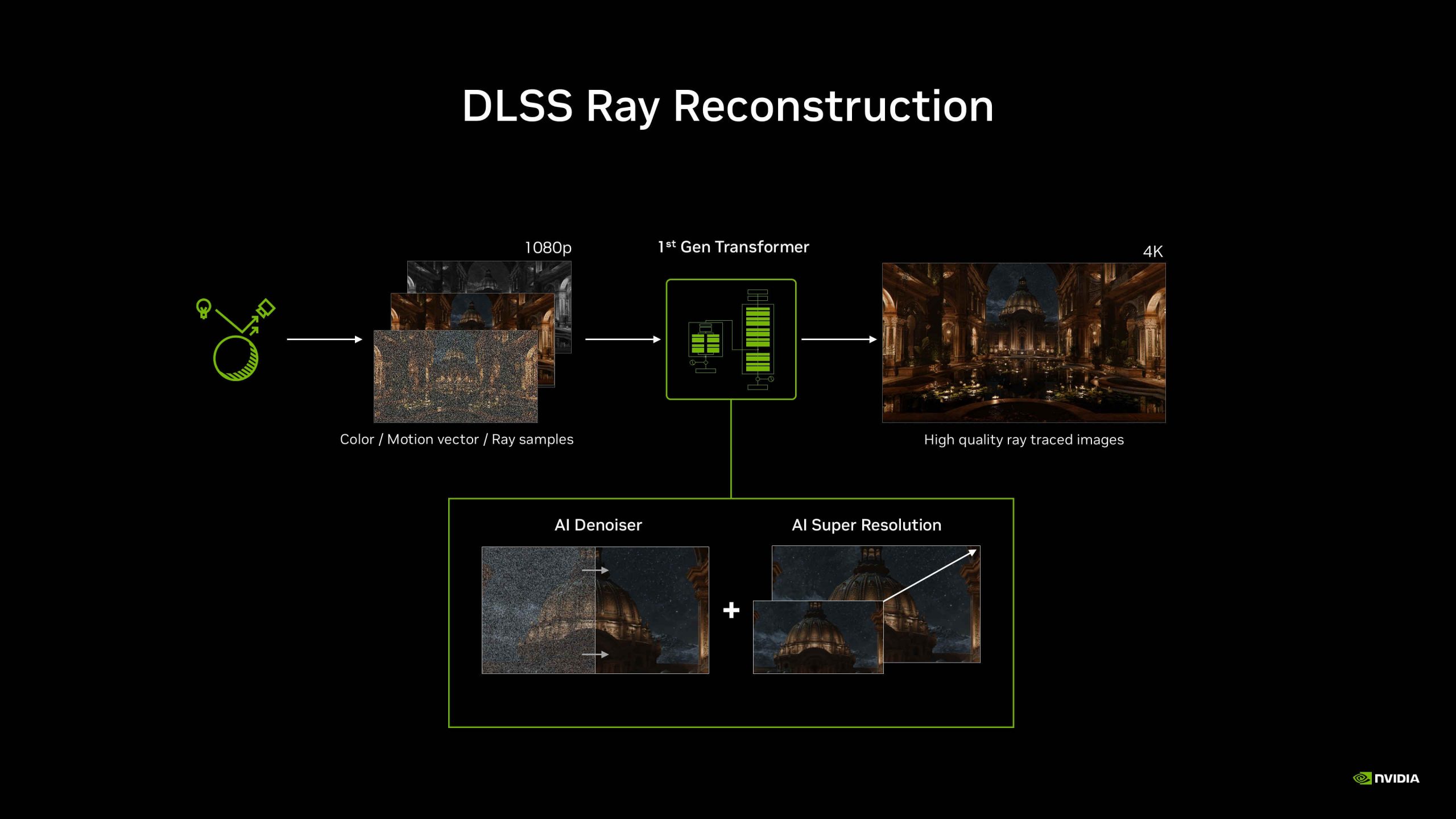
NVIDIA DLSS 4.5 Ray Reconstruction features a 2nd generation transformer model, as per DLSS 4.5 Super Resolution, and like that it enhances all games Ray Tracing effects, delivering a far more stable, coherent, and superior image quality in any ray-traced and path-traced titles. And just like the previous updates it is fully supported across all generations of RTX GPU’s right back to its 2018 release in the RTX 20 series, meaning no one gets left behind. As I covered in the DLSS 4.5 coverage though, the newer Blackwell architecture of the 50 series cards, can run these latest feature set more efficiently, both in compute time and memory footprint, due to their NVFP4 support (where applicable) and ADA can also natively support NVFP8. The older Ampere and Turing GPUs have to rely on more costly FP16 support, which means the performance cost on these cards can be higher than the RTX 40 and certainly RTX 50 series cards.
As before, this half step forward is an improvement on the same feature set and image denoising , reconstruction we saw in Ray Reconstruction 4.0, a neural rendering technique exclusive to GeForce RTX GPUs. The technique specifically targets any ray-traced and/or path-traced effects within a games engine rendering. The aim here is to replace, or severely reduce, the need for developers to hand-tuned denoisers and sparse sampling artefacts on a scene to scene, or effect to effect level. Relying on NVIDIA AI trained networks which are able to do more with less. Reducing the wobbling, dithering, and at times, heat haze like effects we see in Ray Traced effects. Such as Reflections, Ambient Occlusion, Global Illumination. As these effects are samples at far lower rates than the games final pixel output, these can look low quality and noisy in many games, even with RTX GPUs. Ray Reconstruction upscales and stablises these elements by converging multiple samples across many frames and greatly improving the final image output. This new model brings all the feature set of DLSS 4 into a single 4.5 solution, which provides all PC gamers with a far cleaner, stable and higher-fidelity output. It offers performance and quality improvements with the Denoiser offering 35% higher compute capability, across 20% more parameters and roughly similar performance cost as the prior 4.0 model. Super Resolution also gets a boost here with better spatial and temporal sampling across each scene, improving the final light, texture or colour result but can also use or ignore more elements within the engine to increase stability, sub pixel detail whilst reducing ghosting. Finally, it offer a greater level of Developer Control, still allowing teams to fine tune the feature set on an effect or scene basis, so they can achieve far closer ground truth outputs at a much cheaper cost.

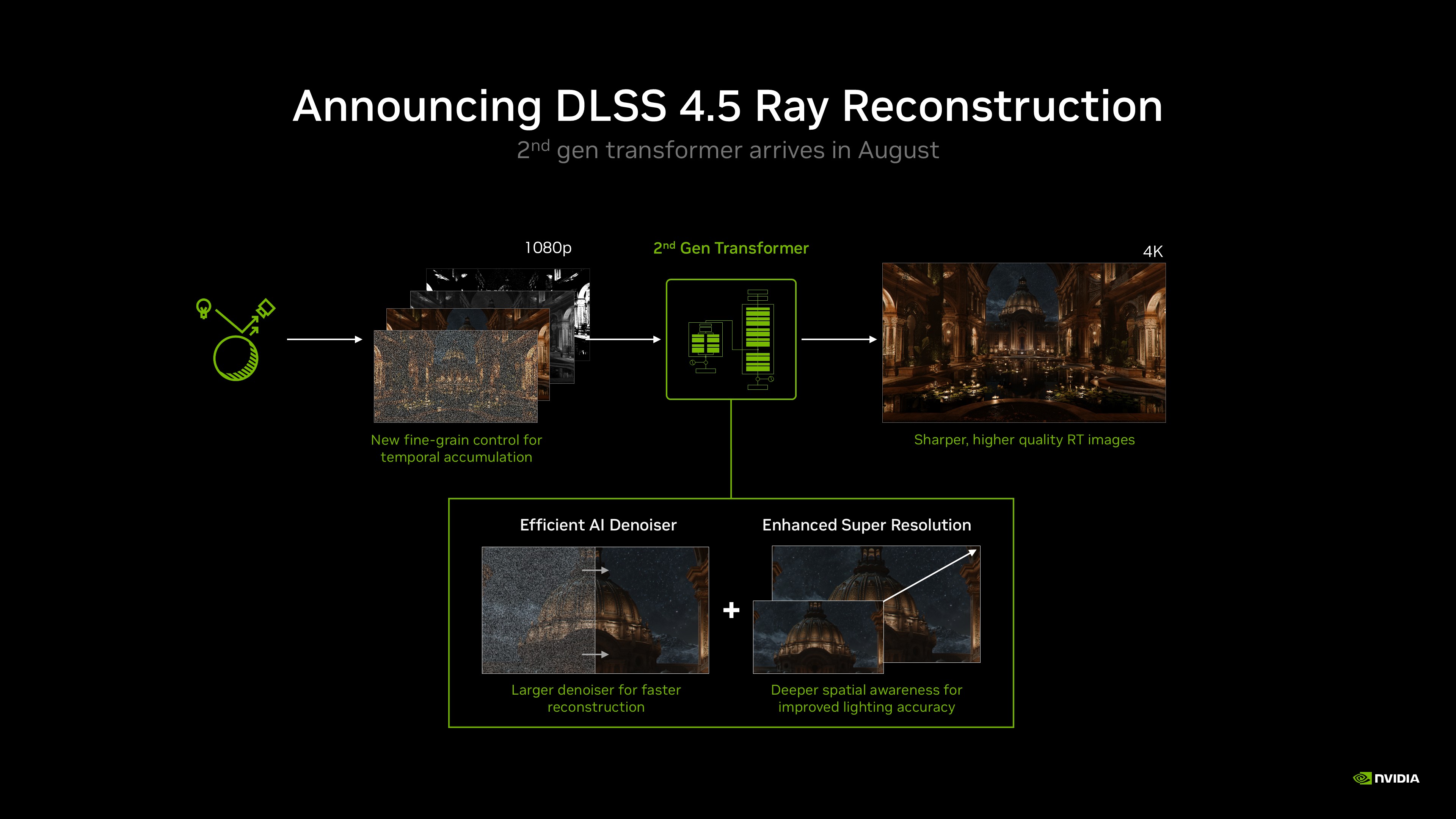
So when and in what games, can we expect to go hands on with this new feature set. Thankfully we only have to wait until August when it will be added to all RTX GPUs via the latest Nvidia App, and that will support 27 games right out the gate, Older games such as Portal RTX, Alan Wake 2, Indiana Jones and the Great Circle and Doom: The Dark Ages. But also newer games in Crimson Desert (which will be a big win I am sure), Pragmata and the latest Resident Evil:Requiem.
Be sure to check back around then when we will cover a selection of games across the RTX GPU range, and be sure to watch or read many of our other videos and articles on the YouTube channel and website.