007 First Light: PS5 vs PS5 Pro Technical Review
Share the Story:
Bond, James Bond!
James Bond is an English icon a ladies’ man with a honed assassin skill set & even sharper tongue. From Ian Flemming novel origins, movies and game history he has been an icon. But since the tail end of Pierce Brosnan and Daniel Craig’s stints as the Tuxedo clad super spy, the series, and more so character, have been gradually watered down, and ultimately smothered to death. With this latest, reboot in a modern world powered by IO interactive Glacier engine with bespoke effects, stunning locales and more than a hint of adventure within.
On PS5 we get 2 modes, 30fps Quality and 60 FPS Performance modes, as I covered last year over on IGN in my preview. I suspected and even showed points in the demo that clearly highlighted memory limits and throughput/bandwidth bottlenecks and that 60fps was a target, and in the final game they achieved it, with some minor cuts. Of the 2 modes base PS5 has, it is a genuine conundrum to pick which is best based on the comprises both have, something fixed or dramatically improved on the Pro. But the 60fps mode does a great job of maintaining an even, consistent 16.7ms frametime. Racing through cobbled streets, fighting 20 guards or taking your licence to kill to the extreme. It achieves an impressive perf rate, and flips the fears following last year’s demo on their head. Where that could seriously struggle to hit 33ms or even 50ms with my assumption of memory/data limited being proven true in the final game. As we are now 3x + faster in the performance mode. We do still see memory or code bugs causing some dips which are a mix of intended, and still related, directly or not, to memory, be they allocation, bandwidth or otherwise. Changes of camera can have held frames to warm up caches and such or just data seeks. But also, GPU and even CPU limits with some bouts into the low 50s, highlighting bugs or memory these can be worse the longer you play. Never terrible but noticeable in the reveal level having played through for a few hours we see these lows but restarting the game and playing again we are mostly locked to 60. So be aware of long runs if performance dips, save, quit and restart to resolve.
You Only Live Twice
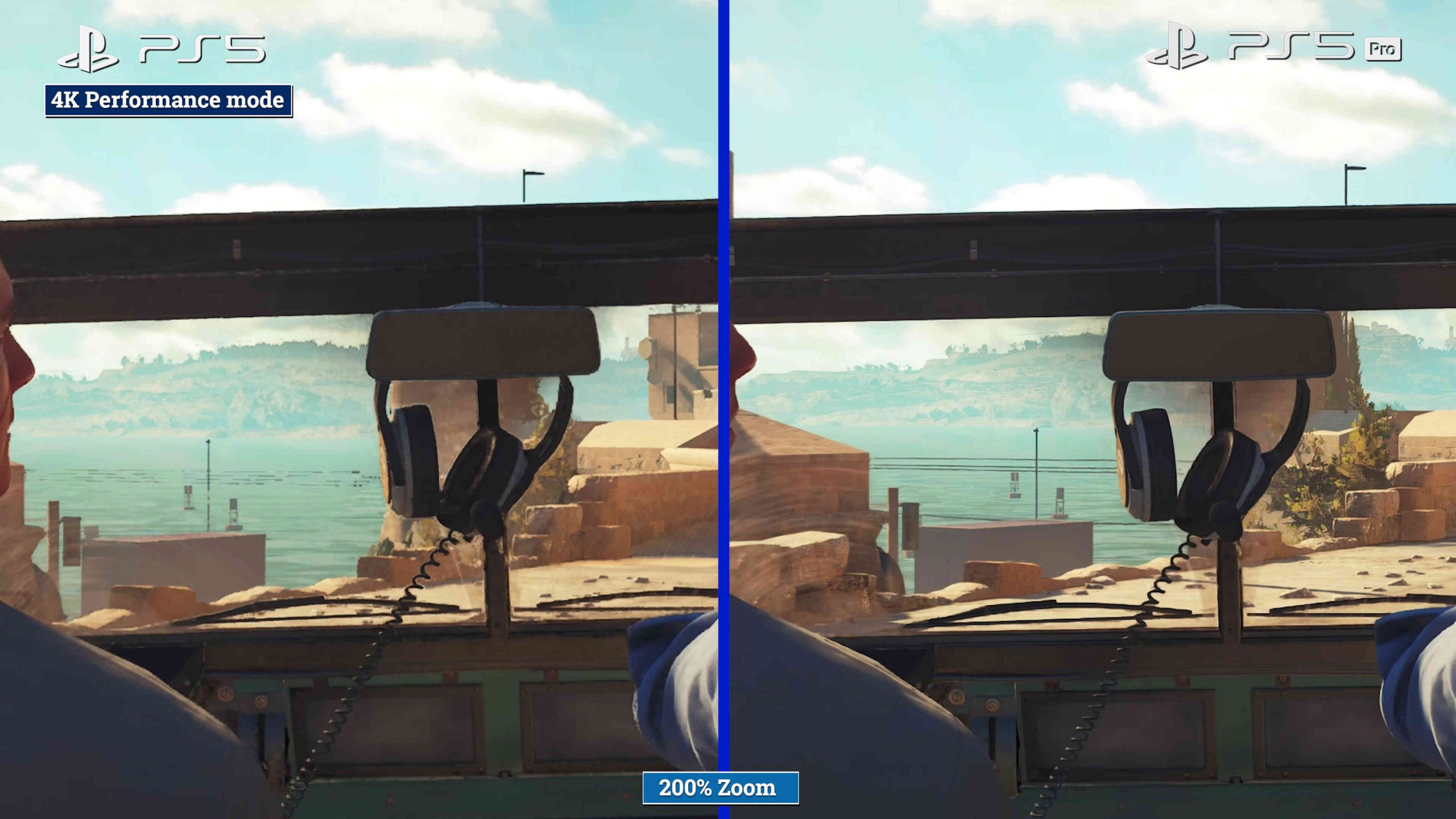
PS5 Pro has a single 60fps mode, using PSSR2 and that is the promised best of both. With far superior iQ and even better performance with the extended, mem related issues seeming less likely to occur. Some mild drops can still happen but overall it is a great increase over the base version, removing the need to choose, mission accomplished on that score making performance concerns a non-issue on both consoles, by and large, but Pro is better in all areas than the PS5 in both modes.
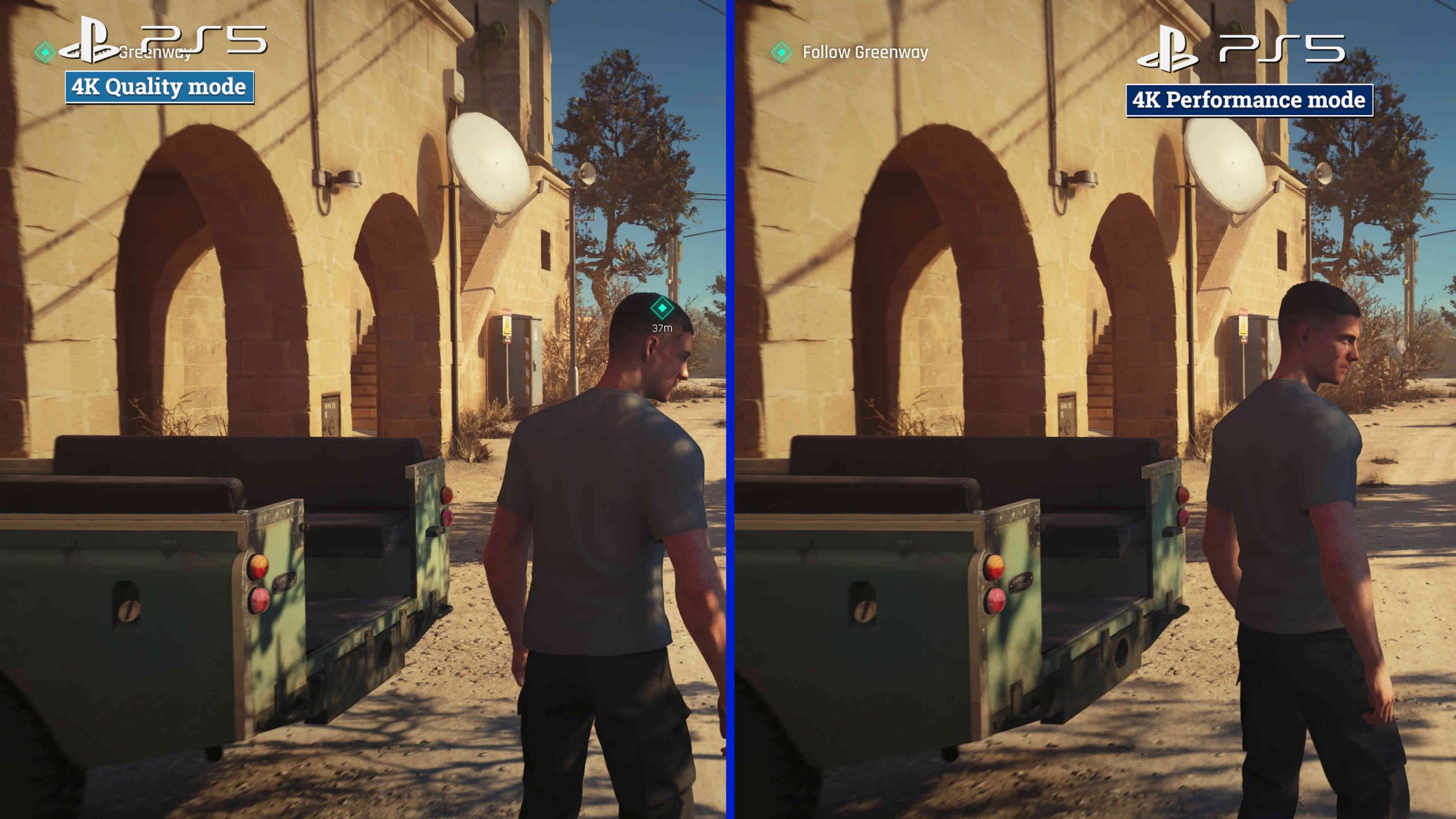
Quality mode is locked to that 30fps target even better, with no concerns, even prolonged play is not as prone to issues but again a handful of dips can infrequently occur. Hats off to the team for achieving such a consistent level and genuine 30 and 60fps mode rather than mere targets. Sadly though input latency is a big cost of the improved Image of quality, far more sluggish controls with a treacle-like 248ms median latency feels very heavy compared to Performance mode’s, still high, 163ms, some 35% faster which feels much more responsive and snappy to play in combat, driving and certainly shooting. As such this mode remains my recommended choice for PS5 players, even though Image Quality is a big cost for it.
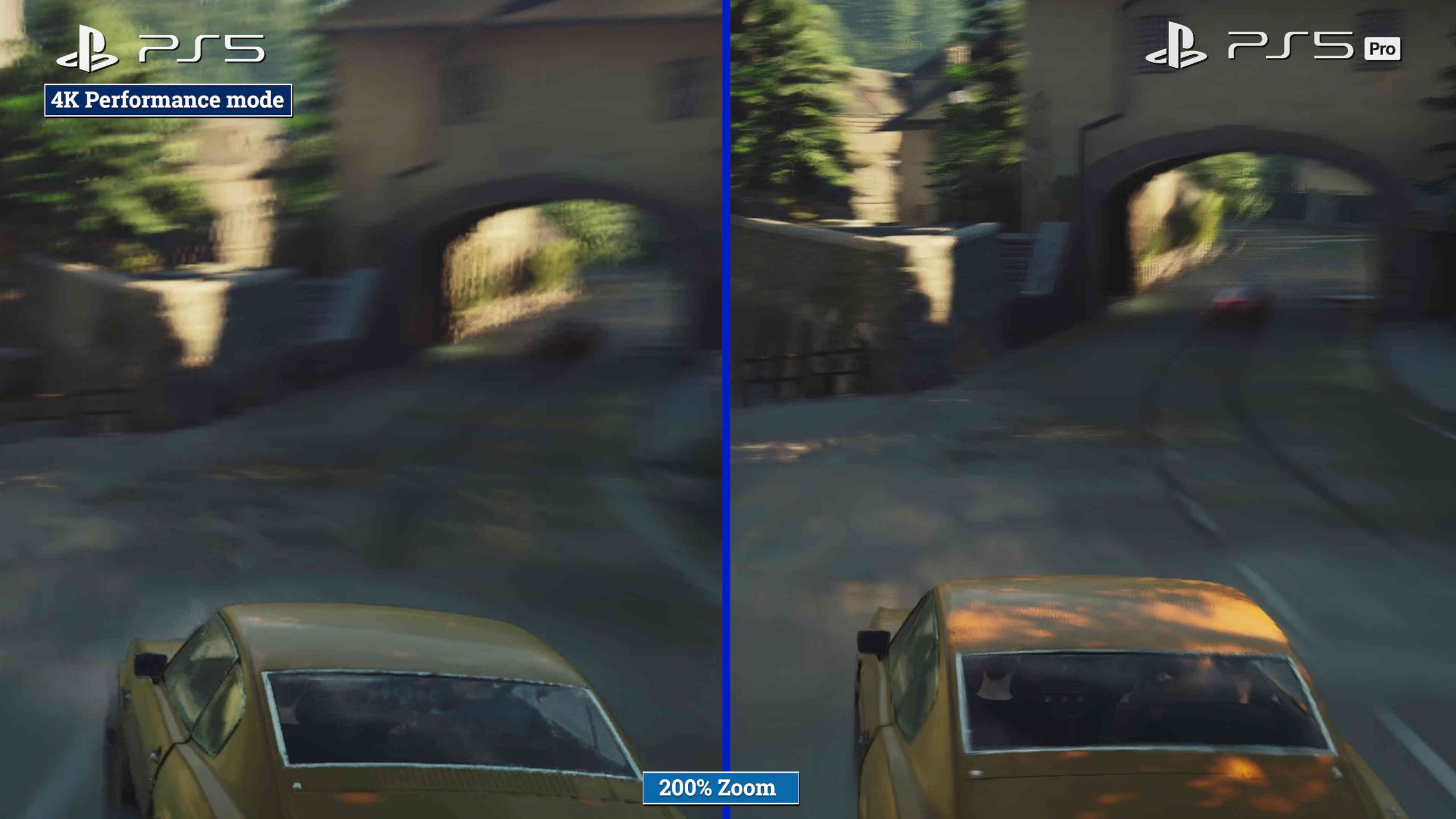
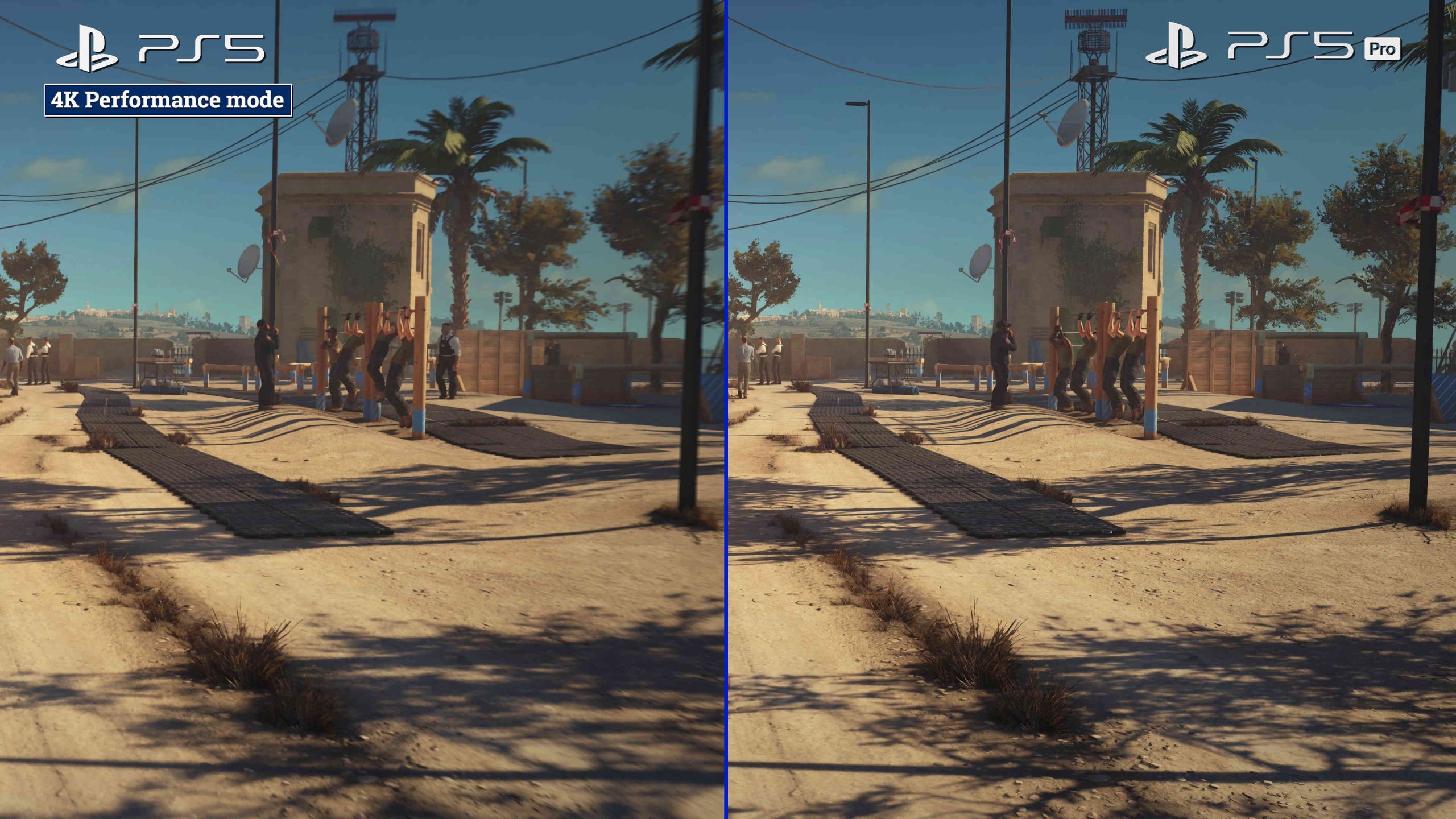
The consoles differ most with image quality more than Effects, with only minor cuts to shadow resolution and filtering, base resolution, texture filtering. PS5 Pro is better than PS5’s Quality mode but PSSR 2 is a huge reason alongside resolution and FSR3’s core weaknesses. All target a 4K upscale with PS5 Pro and Quality mode able to render at an approximate 2560x1440p high to 4K with a low of around 1152p on PS5 and I could only get a low of 1080p on PS5 Pro with even fast motion counting out to 4K. PSSR2 is superb, creating a stable, sharp and coherent image at almost all times, aside some minor ghosting. Performance on PS5 is much worse, seemingly topping out at 1080p and hitting a floor of 1280×720, but most counts were around 900p upscale to 4K. But the cost is specular shimmer, thin geometry and Ao, RTGI fizzle across many surfaces, volumetrics, shadows, grass, everything breaks down far more making the cost for frame-time quite obvious, with PS5 Pro often looking like a higher end PC version in comparison.
GoldenEye
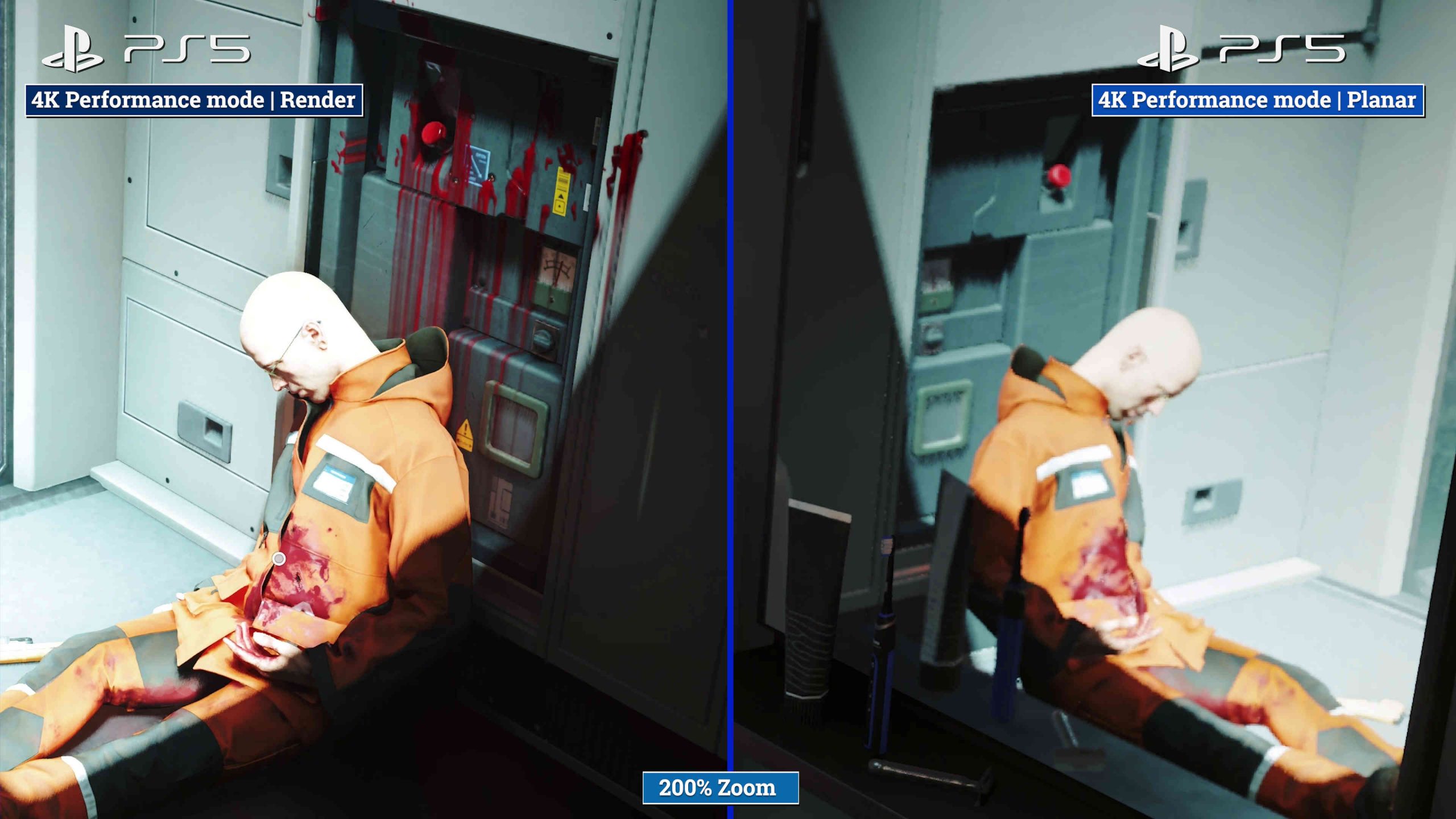
Visually both modes offer near feature parity across textures, model quality, level of detail, NPC count, even the planar reflection proxy quality and, largely, Half resolution rendering are a match. As is the games dynamic Ray Traced Global Illumination(GI), which offers full dynamic GI radiosity bounce, and Occlusion. It uses a software Ray Tracer that calculates the light bounce from sun or moon, the diffuse surface colour and local bounce and then falls back to signed distance fields further away. It operates within screen not world space, including Ambient Occlusion, and it does offer up great outdoor and interior lighting, characters receive surface albedo colour and self Occlusion is good indoor and out. The screen space nature of the effect though can stand out when occluded by Bond or other objects, leaving obvious halos around heads as AO draws out or in as it moves. Reflections on oblique surfaces or non mirror materials mix projected cube-maps with Screen Space Reflections(SSR), which fades out based on edge of frustum or depth buffer samples. It does improve image detail and surface accuracy but both effects can be noisy sometimes due to the sparse sampling they use as noted FSR3 is poor at blending and de-noising compared to PSSR2. Planar reflections remain a strong point, no Ray Tracing but the resolution and reduced geometry of them can be let down by the resolution of the viewport, reduced geometry details and Anti-Aliasing, with Performance mode being the most impacted. The reflections, like Hitman, run at a lower resolution of the main game render.
Engine features
Physics continue to be a strong point of the engine, characters use inverse kinematics, objects break dynamically, toilet bowls, glass, doors. Cloth billows and wraps around, cars slide and crumple, hangers explode, objects bounce, collide, but characters are the strong point though. In combat they move well, as does bond, all use Contextual animation with hands reaching out as you walk past desks or walls. Not new, even The Getaway on PS2 had this feature, but here it resembles Naughty Dogs strides in animation with the Uncharted games and the TLOU 1 and 2 with (motion matching). Which makes its way into the game, offering up a dynamic set of animation routines that can be dynamically loaded, stitched together and synced at runtime. Offering up a very Naughty Dog, Insomniac like combat system, which is superb and weighty from an animation perspective. Bond can evade, parry, grab, muay tai enemies with dynamic takedowns, fancy disarms, foot fondling gun action and more. With the camera swinging in and around to get you the best view of a sunken knee or knock out blow, equally true for the takedowns. Animation is certainly a huge increase for the team, which was good in Hitman, but here they have excelled, with far more fluid, weighted and tighter animation routines, which makes combat very satisfying. Some issues can occur with timing, sync points and warping but this was also true, to a lesser degree, in TLOU2.
Crowds continue to be a big plus for the teams, and here Bond is rarely on his own. With huge chess championing crowds, guard swamped rooms, nightclub ravers and shipwrecked markets. All these NPc’s car chasing and plane flights highlight that Data Streaming has been improved and as noted in my preview, still remains an area to refine within the Glacier engine. It is doing a great deal, but it can be the single biggest cause of dips and even 1 second long or more pauses. Another is long load tines, as the data, physics, state models and more are reset we can see reloads or fresh loads can be 10-20 seconds even on PS5 and much slower on weaker hardware, such as the Steam Deck.
Painting with pixels
Cutscenes and character models are great, as is hair. Cropped into black bars it helps resolution counts but emphasises the cinematic Aims. I also appreciate they align to 30fps or 60fps dependant on mode chosen. Skin, faces, eyes, clothes and hair all have reached a level much closer to Sony first party or other tech strong teams such as Remedy, Capcom, and co. Extending the engine more with hair strands and excellent character modelling and animation is both impressive and as I often say, should be more prevalent than homogenised engine tech. The in-game models are not as well lit, animated or framed but they still look good. As does the games Art and materials, which present superbly right from the camera iris reveal of the Opening sequence, the Maurice binder muse opening credits, complete with David Arnold and Lana del Ray theme song, it looks, feels and delivers an exquisite bond universe complete with stunning, globe trotting locales and pretty people, well mostly. The only let down is the games pop in and image stability, with base PS5 suffering with lots of sub pixel noise from specular, reflections, AO, hair and more. FSR3 has been built into the games engine, even on PC you cannot easily swap DLL’s to FSR4, which means NVIDIA and PS5 Pro players get a far superior image, More-so than should be the case. Quality mode on PS5 is better, offering sharper textures, cleaner resolve, better shadows and lighting accuracy. However, the cost to input latency and frame-time is too big, in my opinion, to make the trade a worthy one. But check out my PC review for more on this subject. Suffice to say that the sharp dressed assassin is not as sharp on the PS5 and certainly Xbox consoles.
Gameplay and impact
Rebooting Bond is common place from his early 1950s origins, through the iconic 60s movies style, 70s Tongue-in-cheek, 80s anger and 90s debonair decline, culminating in the 2010s emo fuelled brick bourne bond. This latest ticks the same current trend of young, cock sure retelling we have almost come to expect. The Story is not original, surprising, or particularly well written, but it does not have to be. It manages to feel more like a Bond film than the last few entries from the cinematic avenue, even the facial scar from the books is included. He has a similar Moore, level style quip heavy approach and is certainly not lacking in self-confidence. It hits the tropes you would expect, including Q gadgets and obviously avoids the flirting, sexual style made famous with Connery and Moore, and as a game first and foremost, IMOP, that is for the best. The tutorial is well done, but far too long, the connection it tries to build falls flat in my opinion, but I did enjoy the opening level and how he starts his journey, even though it was far more Netflix than Pinewood.
The game heavily focuses on Dynamism and stealth with the ability to flip flop from violent action back into spy like stealth. Which is a good idea, carried over from Hitman like many things, but ruined by poor AI and visibility cones, using obvious state models, view cones and very little self-preservation. The puzzle-based progression of some levels is varied but often using a gadget or fist negates the need for subterfuge, which is a shame. Animation is excellent but can be buggy, with clear timing issues on motion matching, clunky moments and in play far too many scripted moments that can work great one minute, then seem awkward the next. Also, some of the best sections are not playable or off the sticks, which reduces the engagement in some potentially superb sequences. The team clearly played and loved the Uncharted games, specifically Uncharted 3 and 4 being key sources of inspiration, the set-pieces, and mix of level styles and change of pace is a great idea and some work better than others. But it never feels quite as polished as those games in execution or extravagance, but they are a smaller studio and pacing is superior here compared to UC4.
Final verdict
A competent, well made, and enjoyable game that is a great start for IO to leave the Hitman franchise and build up in the Bond universe. The in-house Glacier engine certainly has the flair with the noted highlights also including their new fog volumes, utilising Ray marched voxels that sample light, shadow while casing their own. They add purpose and presence in the game over the now standard but largely passive clouds. Extending the engine more with modern hair strands and character digital scan modelling and animation, along with physics driven animation raises the team above many who use off-the shelf teams and I applaud IO for investing in their own engine in the face of such adversity to follow the market consensus. I hope the games 3 million and growing sales secure them a bigger budget and timescale to push on for the next entry now they have established a great base and starting point. As a technical showcase it presents well, and a level I think will become more standard in the triple AAA space, the lack of real disc code does hit hard and I mark them down a notch for that. The online play also seems tacked on and I am happy you can choose to remain offline, once you have installed it anyway. Bond is back, but whether he remains is still up for debate, but this is certainly his best pixel based offering since Nightfire, Goldeneye remains safe for now.